
Development of materials for solar cells
Recently, solar cells have drawn great academic and industrial attentions as a promising candidate of future energy source. But the silicon-based solar cells which occupy above 80 % of solar cell market demand very high cost. Therefore, the wide use of solar cells is not realized yet. To use the solar energy as a future energy source, it is necessary to develop solar cells at a low cost.
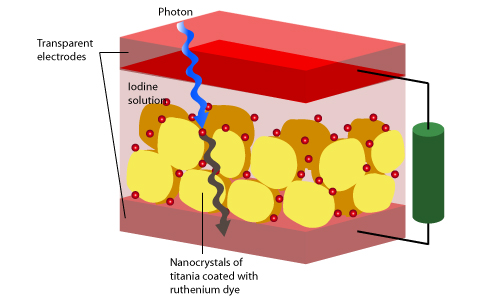
Organic and organic-inorganic hybrid solar cells are expected as alternatives of Si-based solar cells. Especially, dye-sensitized solar cell, a kind of hybrid solar cells, has a great potential because of its relatively high efficiency and low cost. Dye-sensitized solar cell (DSSC) is consisted of mesoporous TiO2 working electrode, Pt counter electrode and electrolyte. In addition, dye molecules are absorbed on the TiO2 surface. The dye molecules absorb sunlight and generate photocurrent. Large surface area of mesorporous TiO2 enables to adsorb large amount of dye molecules. Therefore, high photocurrent can be generated.
Our research is focused on the development of efficient materials for solar cell application. Most of all, we have an interest in nano-structured materials for DSSC. Nano-structured TiO2 is a key material for efficient DSSC. We have researched about one dimensional TiO2 nanomaterials, i.e. TiO2 nanorod and nanotube. We have demonstrated that one dimensional TiO2 nanomaterials represent an enhanced charge transport characteristics when comparing with TiO2 nanoparticles. TiO2 nanorod can transport photoelectrons more efficiently than nanoparticle, due to the reduced grain boundaries which act as a recombination center. And, we also have a technology of preparing a vertically oriented TiO2 nanotube by using an anodization method. Because of its vertically oriented structure, it has advantages in light scattering and charge transport. These researches about nanomaterials will be able to enhance the cell efficiency of DSSC highly.