
Electrochromic Devices
Electrochromism, the reversible change in optical properties when a material is electrochemically oxidized or reduced, has a long history of fundamental and practical interest. While materials were considered ‘electrochromic’ when they showed marked visible color changes, recent interest in electrochromic devices for multispectral energy modulation by reflectance and absorbance has extended the working definition. Electrochromic devices are now being studied for modulation of radiation in the near infrared and microwave regions and ‘color’ can mean response of detectors of these wavelengths, not just the human eyes. An attempt for commercial use is tried these days. Three main types of products are interested: display, mirrors, and smart windows.
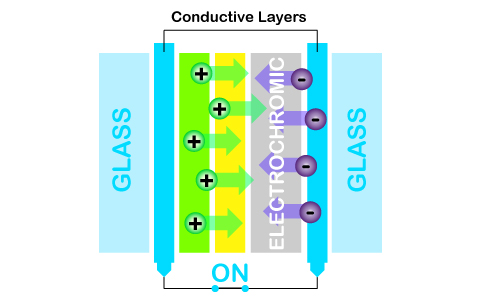
Our research is focused on the EC mirror and smart window fabricated by inorganic materials. In EC mirror, if intensive light comes, electrochromic materials go to the colored state and reduce the light by absorbing it. This system is applied for rear view mirrors in cars or trucks to prevent the dazzling during driving a car. Secondly, smart windows, the most important application of electrochromism, are used in energy-efficient architecture because they would adjust the inflow of luminous radiation and solar energy through glazing in buildings. Therefore, buildings save more energy in heating or air conditioning.
We fabricate thin films of electrochromic material by many methods; RF sputtering method, DC sputtering method, sol-gel method, electrodeposition method, etc. Structures of these nano-scaled or micro-scaled thin films are required for porous structure to intercalate ion easily. Using these thin films, we assemble the EC devices, all solid state system and solid-liquid system, and measure electrochemical properties for testing EC performance. We aim to improve durability, stability and switch times required for color change.