
Development of materials and processing for fuel cells
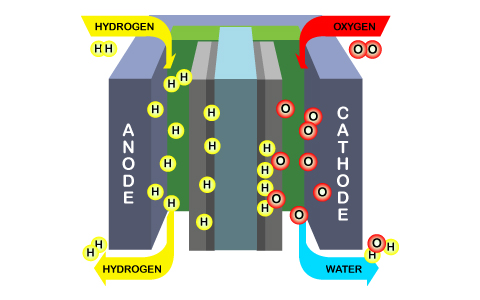
The fuel cell is similar to a battery. It produces electricity using chemicals. The chemicals are usually very simple, often just hydrogen and oxygen. In this case the hydrogen is the “fuel” that the fuel cell uses to make electricity. The very important difference between fuel cell and battery is that fuel cells do not run down like batteries. As long as the fuel and oxygen is supplied to the cell it will keep producing electricity forever. The oxygen needed by a fuel cell is usually simply obtained from air. Although the majority of fuel cells use hydrogen as the fuel, some fuel cells work off methane, and a few use liquid fuels such as methanol. Fuel cells that use hydrogen can be thought of as devices that do the reverse of the well known experiment where passing an electric current through water splits it up into hydrogen and oxygen. In the fuel cell, hydrogen and oxygen are joined together to produce water and electricity. Fuel cells can be made in a huge range of sizes. They can be used to produce quite small amounts of electric power, for devices such as portable computers or radio transmitters, right up to very high powers for electric power stations.
PEMFC (Polymer Electrolyte Membrane Fuel Cells)
PEMFC is attracting much interest because of several merits such as low working temperature, high efficiency, and its small volume. In anode side, hydrogen is oxidized to proton. In cathode side, oxygen is reduced to produce water. The overall reaction is following.
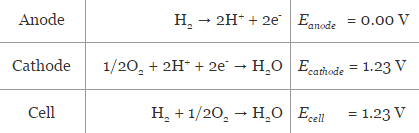
PEMFC is working at less than 90°C and thus usually Pt is used as electrode material. Commercialization of PEMFC needs low cost, high current density, and long-term stability. In this laboratory, design of electrode materials & structure and process of MEA (Membrane Electrode Assembly) fabrication is under investigation.
DMFC (Direct Methanol Fuel Cells)
DMFC uses methanol directly as a fuel without reformer. Anode electrode oxides methanol to produce proton and carbon dioxide, cathode electrode reduces oxygen in air to produce water. The overall reaction is as follows;
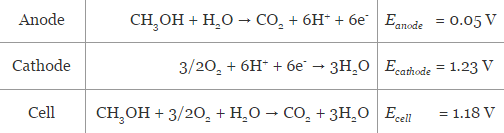
Merits of DMFC are low working temperature (even at room temperature), simple system (no reformer), and very small volume. Therefore, it can be applied to power supplies of mobile phone, notebook PC, and cam coder. In this laboratory, design of electrode materials & structure and process of MEA (Membrane Electrode Assembly) fabrication is under investigation.